%20(1).jpg)
%20(1).jpg)
%20(1).webp)


%20(1).webp)

%20(1).webp)
.webp)
%20(1).jpg)


%20(1).webp)
%20(1).webp)
%20(1)-min.webp)
guPON test
Year 2023
Period 01/01-07/31, 04/15, 07/15
Location New Taipei City Museum of Art
Client New Taipei City Museum of Art
Position Resident artist / First president of Legislature Yuan
Partner Double Grass
Team Ming Yueh TSAI, Yu Min HUANG, Chi Hsiang LO, Ya Wei CHANG, Shih Ting CHEN, Chun Che WU
Photos Yu Min HUANG (footage and photo), Hu-Hsin LIN (photo)
Article Wei Hsiu CHOU, editing by Lucky
When we tap 'check-in' on our phones, what exactly are we taking part in?
Check-In Legislative Yuan is a multidimensional practice emphasizing active participation and sensory experience rather than merely transmitting knowledge. Combining lecture-performance with dream-like deliberation, this artistic action employs the symbol of representative democracy—the Legislature—to question the relationship between people and check-in culture through collective voting. The act of voting becomes a method of public participation and expression, interrogating the essence and mutations of modern "check-in" behavior. Ritualistic elements are integrated to guide participants in reflecting on the connection between digital footprints and technological society.
The project was created during the 2023 opening of the New Taipei City Museum of Art as part of the "Making Circle" residency project. From initial historical research on "check-ins," to mid-term consultations addressing contemporary check-in chaos, and culminating in a lecture-performance, me and my constructed a speculative deliberative space around the museum, inviting the public into this social experiment centered around the question: Should New Taipei City Museum of Art allow check-ins?
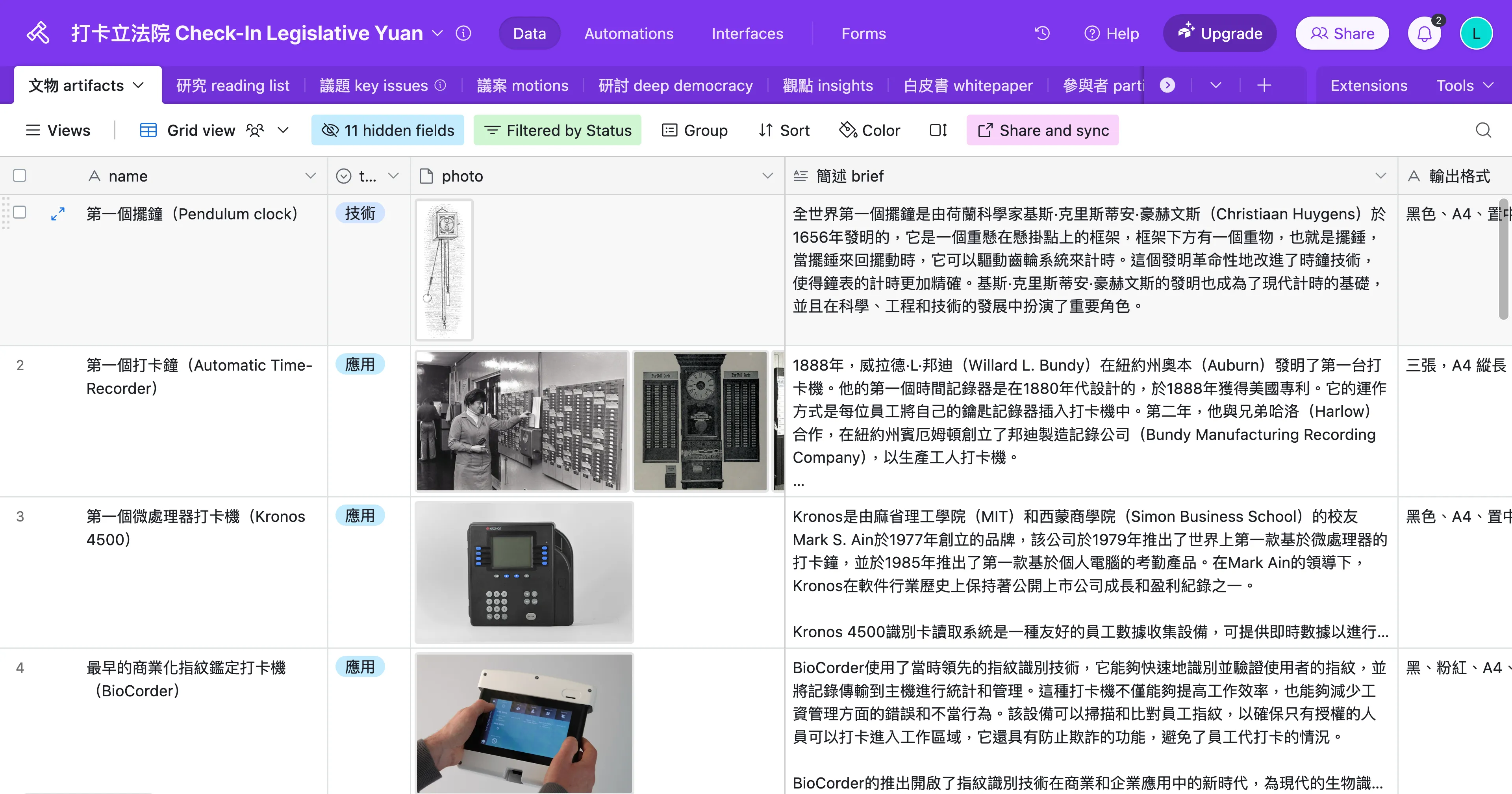
Originally, check-in, or more historically accurate punch-in or clock-in, emerged during the Industrial Revolution as an authoritative measure used by employers to control workers by mandating proof of labor. With the expansion of globalization and digital authoritarianism—often embedded within ranking algorithms—digitized check-ins have evolved, generating extensive databases and attention economies that include locations, timestamps, photographs, textual reviews, and even biometric data. The transformation from proving individual existence to becoming part of an attention-driven surveillance network is the core issue explored by Check-In Legislative Yuan.
Challenge
How can we transform everyday behavior into a social experiment that summons aesthetic momentum? Check-ins encompass historical, technological, social, and political dimensions. How do we facilitate dialogues between history and space, attending to narrative and performative strengths, while linearly guiding participants through multiple layers of the work? How does dramaturgy induce resonance among diverse attendees, prompting them towards "collective decision-making"? Through subtle guidance and a flaneur-like wandering within and outside the deliberative space, how do participants gradually immerse themselves in the dream-like deliberation, gaining nuanced insights into the work?
Strategy
To create a dream-like deliberation, Check-In Legislative Yuan establishes multiple layers of responses. The opening role of the president of Legislative Yuan and ambient sound (created by a hole puncher) immerse participants in a democratic framework both familiar and uncanny, spatializing the act of checking in and linking it to representative authority. Rituals such as the shamaness’s hypnosis and the guidance of cowbell sounds, and the priest’s ceremonial drinks, allow participants to engage sensorially with speculative interpretations of check-ins beyond conventional deliberation. Finally, semi-anonymous voting empowers attendees not merely as passive spectators but as active decision-makers, progressively deepening their contemplation and sense of involvement.
Impact
After sipping the ceremonial drink symbolizing sensory water, participants received two leaves and ascended a tower to vote, reconsidering autonomy and raising the core question: "Should New Taipei City Museum of Art allow check-ins?" Without further explanation, dried leaves signified agreement, green leaves disagreement. As the gavel fell, accompanied by the sound of leaves slicing through the air and lingering hole-punch echoes, participants began to reflect collectively on check-ins as more than individual choices but as embedded in power distribution and cultural discipline.
Continuum
Check-In Legislative Yuan is an evolving social experiment exploring participation, choice, and collective decision-making from multiple aesthetic perspectives. I established an archival database, openly sharing roles, props, and records, allowing anyone to roleplay and locally extend and iterate new sessions, regardless of who assumes roles such as president, priest, or shamaness, continually generating fresh contemplation and practice.
Simultaneously, the project continually questions alternative mechanisms beyond check-ins in an era intertwined with digital footprints. Can a movement starve or alter the algorithm? Can people establish mutual dependencies without relying on data and social platforms? Through ongoing experimentation and reflection, Check-In Legislative Yuan aims to enrich action research in digital ecology, transforming check-ins from mere proofs of existence into profound public dialogue.
-
Team
Artist Yun Cheng CHEN
Researcher Ming Yueh TSAI
First President Yun Cheng CHEN
Second President Chi Hsiang LO
Psychic Ya Wei CHANG
Assistant Psychic Shih Ting CHEN
Priest Chun Che WU
Documentation Yu Min HUANG
Photography Yu Min HUANG, Hu-Hsin LIN, Shu Wei Liang
First Legislators
Ching Shu HUNG, Pei Hsing LIAO, Meng Yu HSU, Ya Ju YANG, Pin Jun LIN, Chieh Hua HSIEH, Jui Ling TSAI, Wei Jen LIU, Feng Chuan SUNG, Chien Tu HUANG, Hsien Lang KAO, Chi ZOU. Yu Yun LIN, Kuan Wen LIN, Chien Min KAO, Hsin Lin YEH, Chung Han HU, Chun Jen TSAI, Chun Yo SHIH, Chun Tzu CHANG. Yu Ying LU, Yi Hsuan CHEN, Ying Ying PENG


